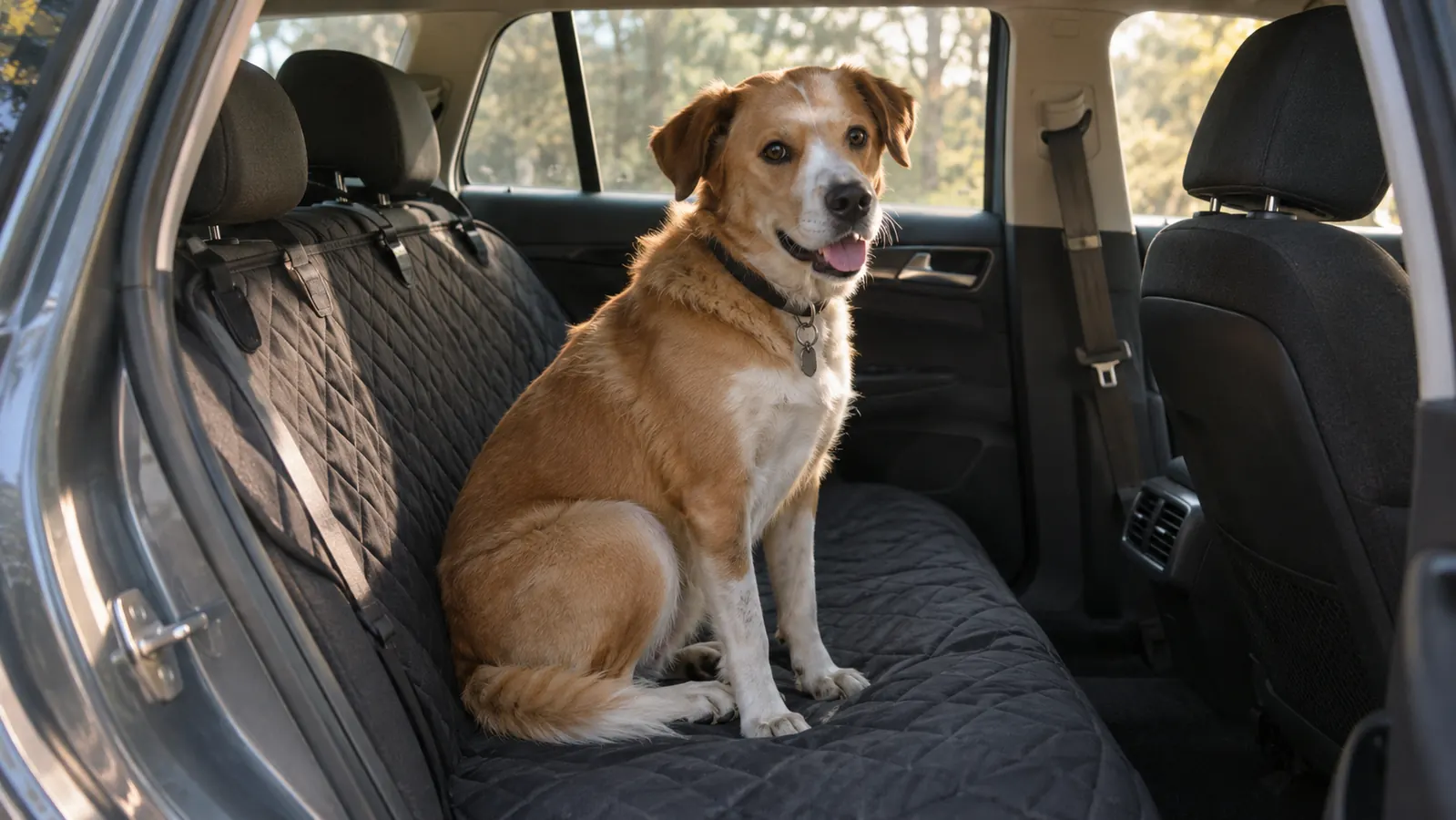
Scout has ridden loose in the back seat of my Outback for two years, and for most of that time I would have told you she was fine. She is eighteen pounds. She sleeps on the straight stretches. Then she decides she needs to see what I am doing, and she is standing on the console with her nose against my shoulder at sixty-five miles an hour on I-94, and I am driving with one hand and my chin.
I bought the Kurgo Tru-Fit Smart Harness in the second week of February, nine months ago, with my own money on Amazon. It was the second thing I bought for that car, after the back seat hammock. Nine months and one transport Saturday a month later, I would not drive her loose again. What follows is not a pitch for a brand. It is the ten reasons I stopped letting a dog ride untethered, in the order they actually occurred to me, most of them on the highway.
Eighteen pounds is not the problem. Standing on the console at highway speed is.
The Kurgo Tru-Fit is what I clip Scout into on the back seat, and it doubles as her walking harness at the Tomah hand-off. Measure the chest and check it against the size chart on the listing before you order.
Amazon Check Today's Price on Amazon →It ends the console tour at highway speed
A loose dog picks the worst possible moment to move. Mine picks the moment the left lane is closing and there is a semi beside me. In nine months of clipping her in, that has not happened once, because she has a spot and the spot is not my shoulder. This is not obedience training and I am not going to pretend it is. A dog with eighteen pounds behind her and nothing holding her in place will get where she wants to go.
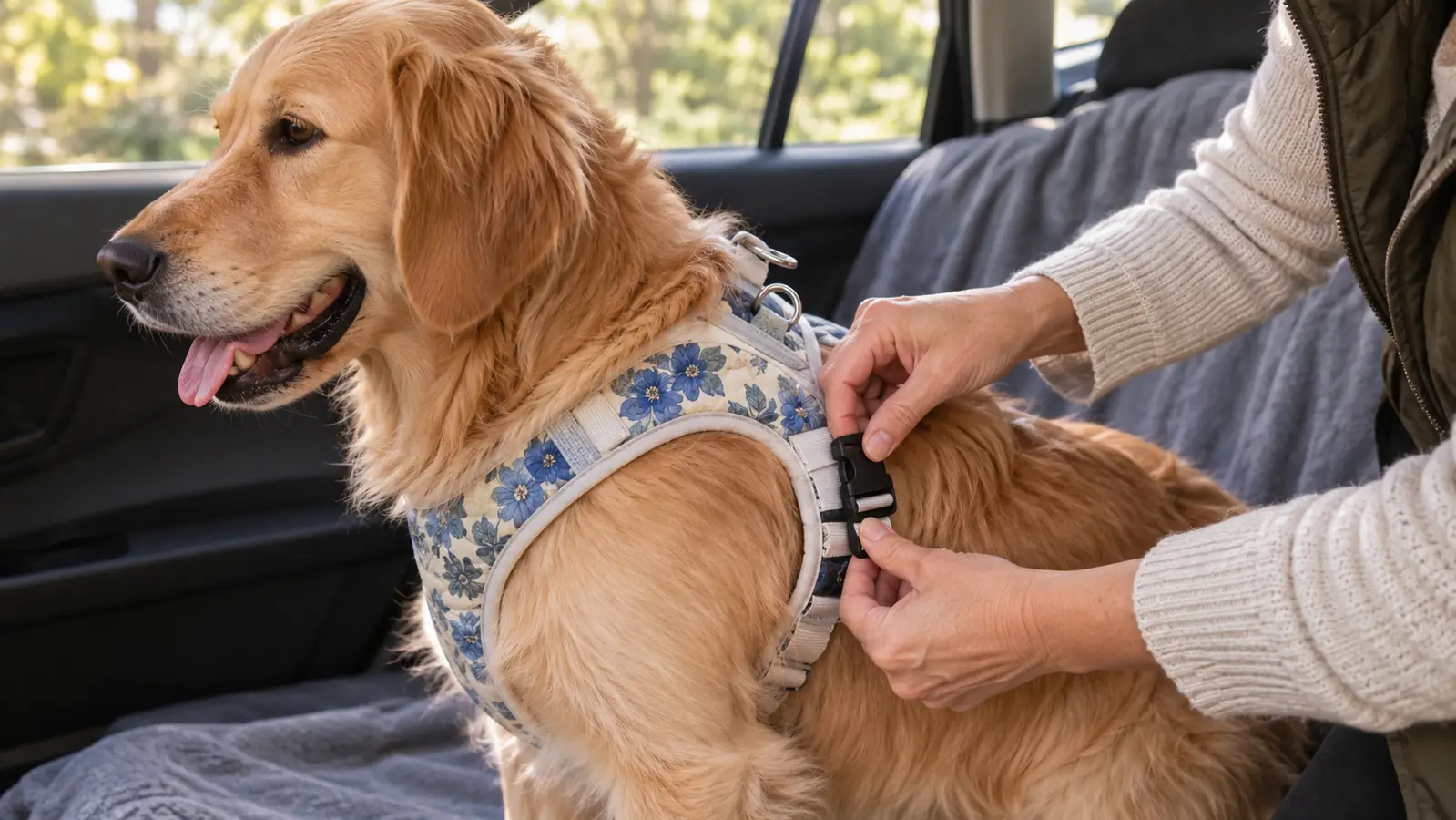
Five adjustment points mean the fit is on the dog, not on the size chart
The harness has five adjustment points, and the first fitting took me most of a Saturday morning with Scout standing on the kitchen table being patient about it. That is the honest cost. The payoff is that it sits where I put it and stays there, month after month, instead of creeping around when she leans into the end of the leash. Sizes are not universal. Measure the chest and check the number against the size chart on the listing, because a medium on one dog is not a medium on the next.
Steel nested buckles, not the plastic clips that go brittle in a Wisconsin February
The hardware on this thing is steel, including the nested buckles, and that matters more in February than it does in July. I have had plastic clips on other dog gear crack at twenty below, and the ones that do not crack get stiff enough that I cannot work them with gloves on. These I can work with gloves on. It is a small thing right up until the morning it is not.
One harness for the ride and for the walk at the rest stop
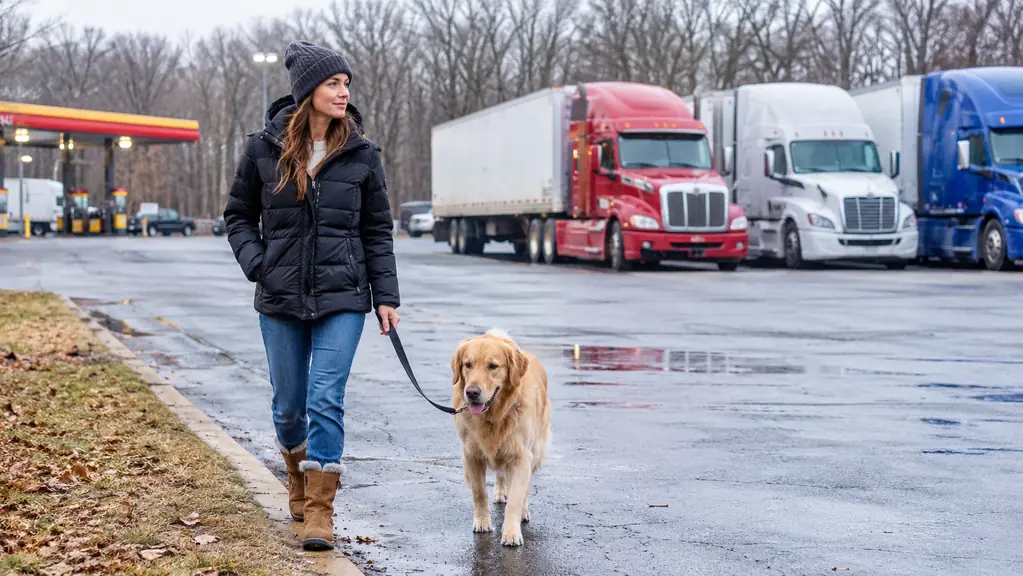
The old routine was a collar for the walk and nothing for the car, which meant at every stop I was juggling a leash, a dog, and a coffee I should not have bought. Now she rides in the harness and she walks in the harness. I clip the leash to it and we go. Nothing gets swapped in a parking lot with trucks moving behind me. That is worth more than it sounds like when you are standing on gravel at a truck stop in the cold.
Leash attachments on the front and the back, so you have a second option
There is a leash attachment on the back and one on the front. I use the back one, because Scout walks politely and I am not going to fix what works. The front one is there for a dog that pulls. If yours leans into the leash, which is most of them, that is the one to use, and it does the job without a special collar and without a second piece of gear in the car.
It is crash tested for dogs up to 75 pounds, and that is a number worth reading twice
The Kurgo listing says crash tested for dogs up to 75 pounds, and it gives the measurements for each size, so measure the chest against the chart. Scout is eighteen pounds, so I am nowhere near the top of that range. I checked anyway. The number is the number, and guessing at it is how people end up with gear that was never built for their dog. If your dog is over that weight, this is not the harness, and you should know that before you order.
A dog with a fixed spot is a dog you are not watching instead of the road
On transport Saturday I drive a dog I met forty minutes earlier. I do not know how it rides, whether it has ever been in a car, or what it will do when a semi passes. What I do know is that a dog with the run of the back seat is a dog I am keeping half an eye on at seventy miles an hour, and half an eye is not enough on I-94. Giving a dog one place to be is the whole point. Everything else is details.
Mud and hair land in one place instead of migrating across cloth seats
My Outback has cloth seats and I would like to keep them. The hammock catches most of it. The harness catches the rest, because a clipped-in dog cannot turn around six times before lying down and cannot work her way from the driver side to the passenger side and back again. The hair stays roughly where she is. I still vacuum it. I just vacuum one spot instead of the whole back seat and the cargo area and, once, the defroster vent.
Getting out at Tomah takes one clip instead of a wrestling match
At the truck stop I put the car in park, clip the leash to the harness, and open the door. That is the whole sequence. The old sequence involved reaching across a moving dog, grabbing a collar, and hoping the leash clip landed before she did. Nine months in, I can do it with one hand while holding a water bowl in the other. If you have ever chased a dog through a parking lot, you know what that is worth.
It moves the decision out of the moment and into the driveway
At sixty-five miles an hour you do not make a decision about a loose dog. You react. By then the dog is already on the console or already in the footwell, and you are already behind on everything. The harness moves that decision to the driveway, where it is a thirty second job and nobody is moving. That is the real argument, and it is the one I would make to anybody who tells me their dog rides fine loose. Mine rode fine loose too, right up until she did not.
What I'd Skip
I looked at other ways to do this before I bought, and here is what I would leave on the shelf. A plain seat belt tether clipped to a flat collar, which is what another volunteer uses on her dog, is not something I would put on Scout, because everything the car does in a sudden stop goes into the dog's neck. I have not owned one and I am not going to pretend I tested it for months. I just know where I want that load to land, and it is not the throat. I would also skip buying a size up to grow into. Measure the chest, check the chart, and order the size the dog is today. And a hard-sided carrier, which a volunteer at the rescue uses, takes up most of the back seat of an Outback and leaves no room for a duffel or a second dog. The harness takes up no seat space at all when she is out of it, which is the point. None of this is a guarantee of anything. It is one less thing going wrong at sixty-five miles an hour, and on I-94 in February that is enough for me.
Nine months, one transport Saturday a month, sixty-five miles an hour on I-94, and she has not stood on the console once.
Ten reasons, one piece of gear, thirty seconds in the driveway
The Kurgo Tru-Fit is the second thing I bought for that car and the one I would buy first if I did it again. Measure the chest, order the size the chart says, and give the dog one place to be.
Amazon Check Today's Price on Amazon →