
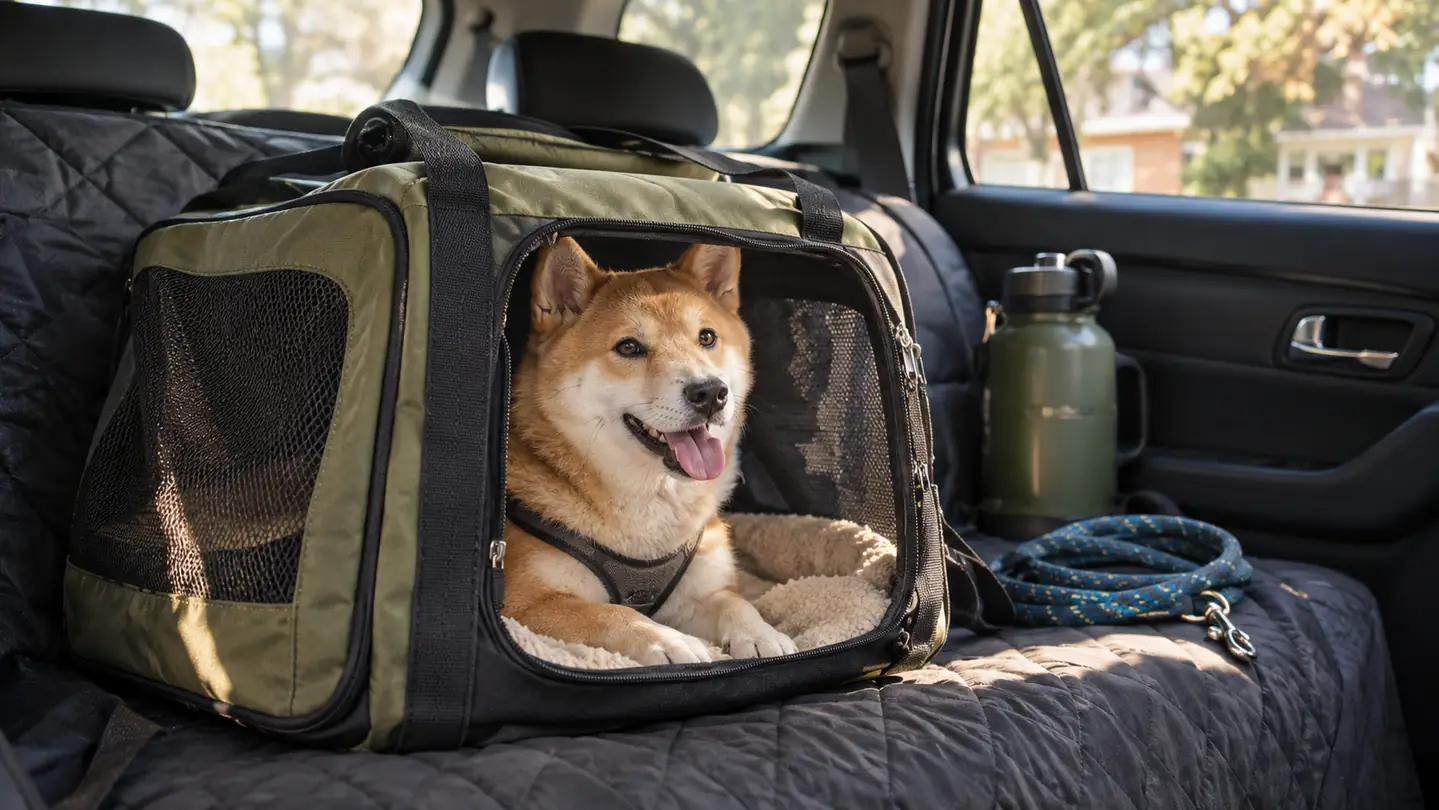
In the second week of April, seven months ago, I bought the Sherpa Original Deluxe carrier in size Large. Not for a flight. For a cardboard box. The small Wisconsin rescue I drive for handed me a dog in a stapled cardboard carrier on my second Saturday run down to Tomah, and by the time I got home the handle had gone soft from the damp. I got on Amazon that night, bought the Sherpa, and I have used it roughly once a month since then, plus three trips to the vet with Scout.
Most of what gets written about this carrier looks like it was copied off the hangtag. Airline approved. Spring wire frame. Padded handle. All true, all in the listing, and none of it tells you a thing about whether the thing will work for your dog. You are reading this because you have a dog, a car, and a decision to make, and you would like to know where the carrier is going to disappoint you. So I will start with the disappointments and get to the good part after, because that is how I would want it told to me in the rescue parking lot on a Saturday morning.
The Quick Verdict
A well-built soft carrier that will do right by a calm dog under about 18 pounds. The 22-pound rating on the label is a ceiling, not a target, and the shoulder strap gets heavy fast.
Amazon Check Today's Price →If you have already measured your dog sitting down, here is today's price
The carrier comes in several sizes and the size is the whole decision. Measure the pet seated, compare that to the exterior dimensions, and let the number pick the size rather than the picture on the box.
Amazon Check Today's Price on Amazon →How I've Used It, In Plain Terms
Scout is a 6-year-old female terrier mix, 18 pounds, adopted from the same rescue. She rides on the back seat of a used Subaru Outback, on a hammock, wearing a harness. She does not ride in the Sherpa. The carrier rides next to her on the passenger side of the hammock, and only when I have a small dog aboard for the leg. Scout also goes to the vet in it, which is the other half of its life and probably the half most people will recognize. I measured her the way a transport volunteer told me to, sitting down, and she came out at 17 inches from the front of her chest to the base of her tail, standing about 11 inches at the shoulder. Hold those two numbers against 19 by 11.5 and you can see the problem before you ever put a dog in the bag. My husband Dale is retired and does not drive transport legs, so on the second Saturday of the month it is just me, Scout, and whoever is riding in the carrier that day.
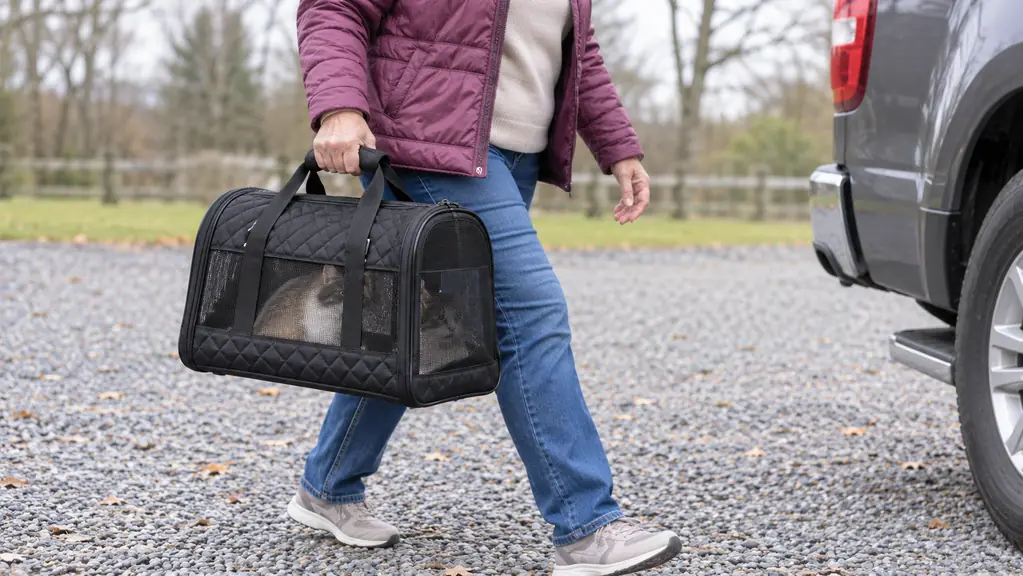
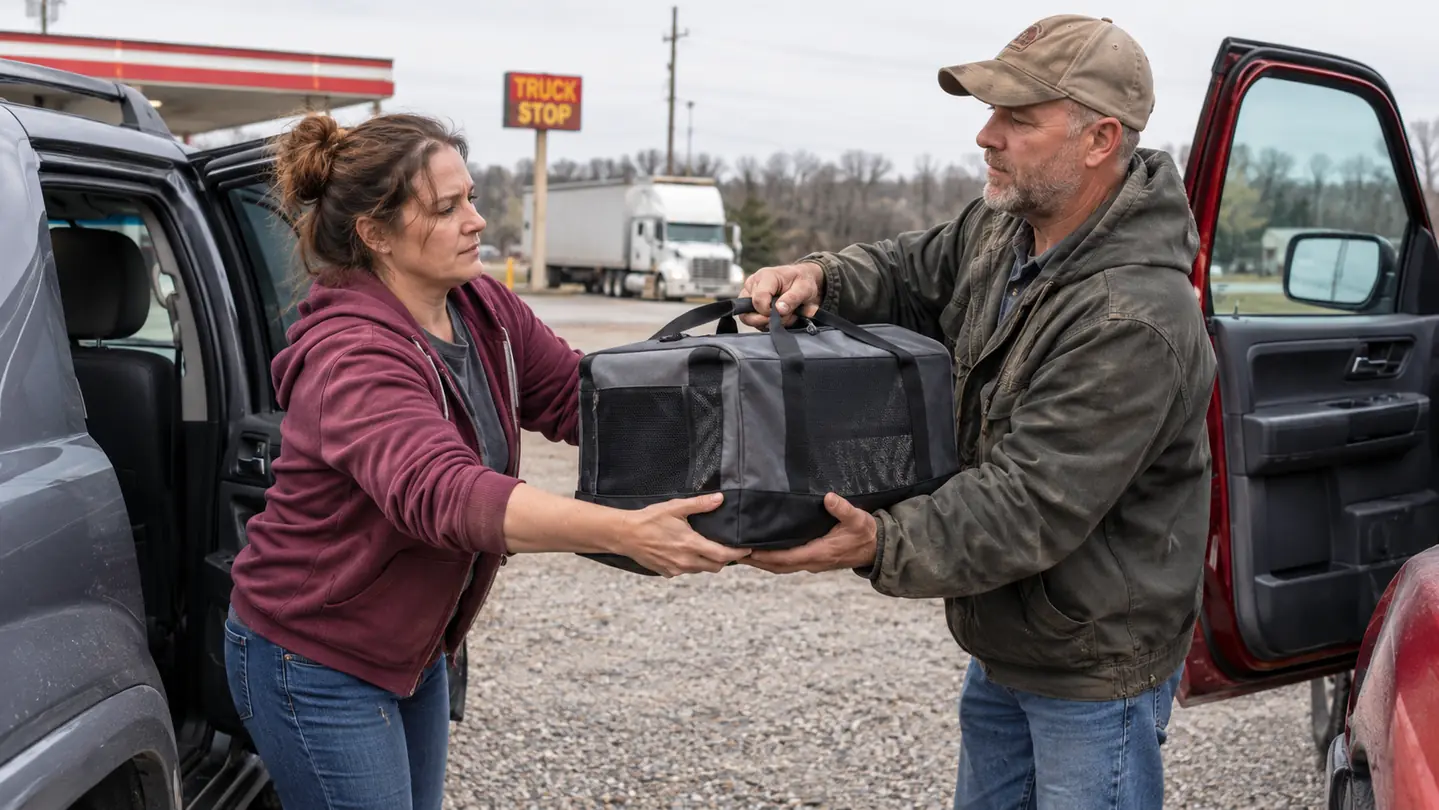
On a transport run, the carrier sits open on the back seat with nothing in it until we are parked at the Tomah truck stop. Then the hand-off dog goes in, the detachable strap goes over my shoulder, and I walk him over to the next driver standing by their car. That is the whole job. Ninety miles down I-94, a hand-off, and back home. The carrier has to do three things. Hold a dog. Carry a dog. Clean up afterward. It does all three, and I want to be fair about that before I get to the complaints. The walk itself is maybe thirty yards of gravel, from my car to theirs, and that is the exact distance this carrier is built for. I have watched volunteers do that walk with a dog under one arm and a leash in the other hand, and it works right up until the dog decides it does not want to be carried that way. The carrier gives you both hands back.
The vet trips are the harder test, because Scout knows where we are going the minute I turn into the lot. I load her in the carrier while the car is parked and carry her inside. She is not thrilled about it. But the carrier keeps her off the waiting room floor, which matters at a vet's office, and it means I am not wrestling a terrier in a lobby with three other people and a cat in the room. The padded top handle gets used for that, not the shoulder strap. Short carry, one hand, done. The last one was a Tuesday morning in September, a nail trim and a weigh-in. I parked in the second row, set the carrier on the open tailgate, put her in, and carried her the length of the sidewalk. The liner caught the hair and the shake-off afterward, and I dumped it in the laundry sink that afternoon. Three trips in seven months and the routine has not changed once.
The shoulder strap deserves its own paragraph, because the listing mentions it and I have opinions. It is detachable and it works. I have carried a 14-pound dog across a truck stop lot with it and it stayed on my shoulder. But with Scout inside, you have 18 pounds of dog plus 3 pounds of carrier, and that gets heavy in a hurry. The strap is not the problem. The arithmetic is. If you are walking any real distance with a dog in this, you will feel it by the far side of the lot.
What Nobody Tells You About the Sizing
The Large is listed at 19 inches long, 11.75 wide and 11.5 high, and rated for pets up to 22 pounds. Those dimensions are honest. They are also exterior numbers, and here is the part that matters. A dog does not sit at 22 pounds the way a sack of flour sits at 22 pounds. A terrier that weighs 18 is elbows and attitude, and Scout at 18 fills this carrier end to end. She can stand in it. She can turn around, barely. She cannot lie flat and stretch out the way she does on the seat. If your dog is 20 pounds and long in the body, this is not the size for you, and I would rather say that now than have you find out in a parking lot with a dog halfway in. Last month's run handed me a dog whose paperwork said 21 pounds, a broad-chested thing with a wide front end. He went in. He did not go in comfortably, and closing the zipper took both hands and a knee up on the seat cushion. He rode the ninety miles to Tomah with his chin over the front edge and his back end against the rear panel. He was fine. I was not comfortable, and I would not make a habit of it. That is the whole reason I call the label number a ceiling.
Measure the dog sitting down, then measure again standing, because those are two different numbers and the carrier has to handle the taller one. I did not think that up. A volunteer who has been doing transport for a lot longer than I have told me, and she was right. A dog that is packed in is a dog that complains for the whole ride, and a complaining dog in a carrier on your back seat is a distraction you do not need while you are merging onto the interstate. The two numbers you want are standing height at the shoulder plus a little air, and length from chest to rump. Write both on the back of a receipt and take it to the computer with you. If the standing height is close to 11.5, go up a size, because the top of this bag does not stretch.
One more caution and then I will drop it. The listing says airline approved and Guaranteed On Board, and I am not going to argue with the listing. But I have never flown with a dog and I am not going to pretend otherwise. If you are flying, call your airline, get the cabin size limit in writing, and measure your dog against that number before you buy anything from anybody. Airline rules are not all the same and they change.
What I Liked
- Sits down into a seat instead of perching on top of it, thanks to the spring wire frame at the rear
- Padded top handle is comfortable for a short one-handed carry
- Comes with a liner, so the hair and the nerves land on something you can deal with
- Detachable shoulder strap clips on and off without a fight
- One-year limited warranty in writing
Where It Falls Short
- The 22-pound rating is optimistic, and a dog near it will be packed in
- Heavy on the shoulder with a dog inside for anything past a parking lot
- Soft-sided construction contains a calm dog, it does not stop a determined one
- Scout at 18 pounds has no room to stretch out
- The size chart is exterior measurements, which is not how you size a dog
Scout is 18 pounds. She fills it end to end. The label says 22. Believe the dog, not the label.
Why the Spring Wire Frame Matters More Than You Think
The feature that gets the least attention does the most work. The spring wire frame lets the rear end of the carrier push down several inches, and that is the difference between a carrier perched on top of a seat and a carrier that sits down into it. On the hammock in the Outback it stays put. A soft carrier with no frame sits on top of a cushion like a laundry basket, and a laundry basket is not where I want a dog. The carrier I used before this one was a borrowed cardboard vet box, and it slid forward on the hammock every time I touched the brake. I spent one run to Tomah with my right hand reaching back to steady it, which is a hand I would rather have had on the wheel. That box is the reason I went looking for something with a frame in it.
The frame does a second job. It keeps the sides from folding in on the dog when you set the carrier down. I have carried this thing with a dog in it, set it on a tailgate at Tomah while we sorted out paperwork, and the shape held while the dog shifted around inside. That sounds like a small thing until you have used a bag that did not do it. It also means the bag stands open on its own while you are trying to get a dog into it, which matters more than it should when you are doing it one-handed in a parking lot with a leash wrapped around your wrist.
Where It Falls Short
Now the honest part. This is a soft-sided carrier. Soft sides are the point, they are light, they give, and they are also not a barrier. A calm dog rides fine. A determined dog with a few minutes and a corner to work at will make progress on fabric and a zipper. If you have a dog that panics in a car or chews when it is anxious, this is not the tool, and no soft carrier is. That is not a knock on Sherpa. It is what the category is, and the listing does not pretend otherwise.
The strap issue is real and I already covered it, so I will only add this. Plan your carries. Park close. Take the shortest route to the door. Use the padded top handle when you only have a few steps, because one hand on a rigid handle beats a strap cutting into your shoulder every time.
And it holds one dog. That is obvious until you are the person trying to move two small dogs from a shelter to a foster home in one trip. Then you are buying two carriers or you are setting up something else. I set up a pop-up crate in the cargo area for that, while parked, and the two tools do different jobs. One carries. One contains. The second Saturday in June I had a pair of them, both under 12 pounds, brother and sister out of the same litter. One went in the carrier. The other went in the pop-up crate in the cargo area with the hatch up while we were stopped, and then got moved into the carrier for the hand-off walk. It meant two trips across the gravel instead of one, but nobody rode loose and nobody rode stacked.
The Other Option People Ask About
I have seen hard-sided carriers at the rescue and I have never owned one, so take this for what it is worth from a person who watched somebody else use one. They hold their shape no matter what and they wipe out in a second. They are also heavy, they do not give at all, and they take up the same room in your car whether a dog is in them or not. For a volunteer who stows a carrier on a garage shelf between runs, the Sherpa wins on storage without much of a contest. With the back end pushed down it takes one shelf slot. A hard carrier takes more and it is a hard thing to have sliding around a cargo area.
The honest tradeoff is this. A hard carrier gives you more protection from the object itself. A soft carrier gives you light weight, a smaller footprint in the car, and a dog that is not sitting in a plastic box. Neither one is an airplane seat, and neither one is a guarantee. I do not say that to be difficult. I say it because I have driven a bus for a living and I know what a marketing word is worth in a parking lot.
Who This Is For
This carrier is for the person with a small dog. Under about 18 pounds to be comfortable, and under 22 to stay inside what the label rates it for. It is for moving that dog from a car to a building and back. Vet visits. Rescue hand-offs. The groomer. A dog that travels in a car and needs to be contained for the walk across a lot. The listing also names cats and small dogs, and the size math does not change for a cat. It is for someone who wants one carrier that lives on a shelf and comes out when it is needed, not a piece of furniture bolted into the back seat.
Who Should Skip It
Skip it if your dog is at or near 22 pounds, or long in the body, or both. Skip it if your dog chews or panics, because soft sides will not stop either one. Skip it if you are flying and have not called your airline, because the label is not the last word on whether a carrier gets into a cabin. Skip it if you want a crate that stays set up in the car, because a pop-up crate does that job better and this is not that. And skip it if you plan to carry a dog more than the length of a parking lot, because your shoulder will have something to say about it around step forty.
What is left after all that is a good carrier with a realistic limit. Seven months in, I have not had a seam go, a zipper fail, or a handle give. The liner has caught what a nervous dog leaves behind and the inside has come clean every time. Scout still hates getting in it, and she still goes to the vet in it, and I still put it on the shelf afterward. That is not a love story. It is a tool that does what I bought it for, with one number on the label I would change.
Measure your dog sitting down, then check today's price
Sizing is the entire decision with this carrier. If your dog measures under the interior footprint with room to stand, it will do the job. If not, go up a size or pick a hard carrier.
Amazon Check Today's Price on Amazon →