Scout is six years old, eighteen pounds, and a terrier mix, which means she has opinions and shares them freely. She still stands up and turns one full circle about twenty minutes into any drive. She is not the hard case. The hard cases are the small dogs I move on my transport leg, handed to me at a truck stop in Tomah and handed off again ninety miles down I-94, and the carrier that does that work is the Sherpa Original Deluxe in Large. It sits on a shelf in my garage three weeks out of four and comes down for small transport dogs, the occasional cat, and Scout's vet visits.
The advice you get about carriers comes in two flavors. Put the dog in and drive, he will fuss himself out. Or leave the carrier on the living room floor for a month and hope. I have watched both go wrong plenty of times, and neither one is really training, it is just waiting near a piece of luggage. What works is duller than that. You make the carrier an ordinary object in the house first, you do it in small pieces, and you give it about two weeks. Here is the version I have run with a half dozen nervous dogs.
Get the Size Right First, Then Start the Two-Week Clock
The Sherpa Original Deluxe in Large measures 19 by 11.75 by 11.5 inches and the listing says it fits pets up to 22 pounds. Scout is 18 pounds and she fills it, so measure your dog before you order and do not assume large means roomy.
Amazon Check Today's Price on Amazon →Step 1: Park It Open in the Room Where the Dog Already Rests
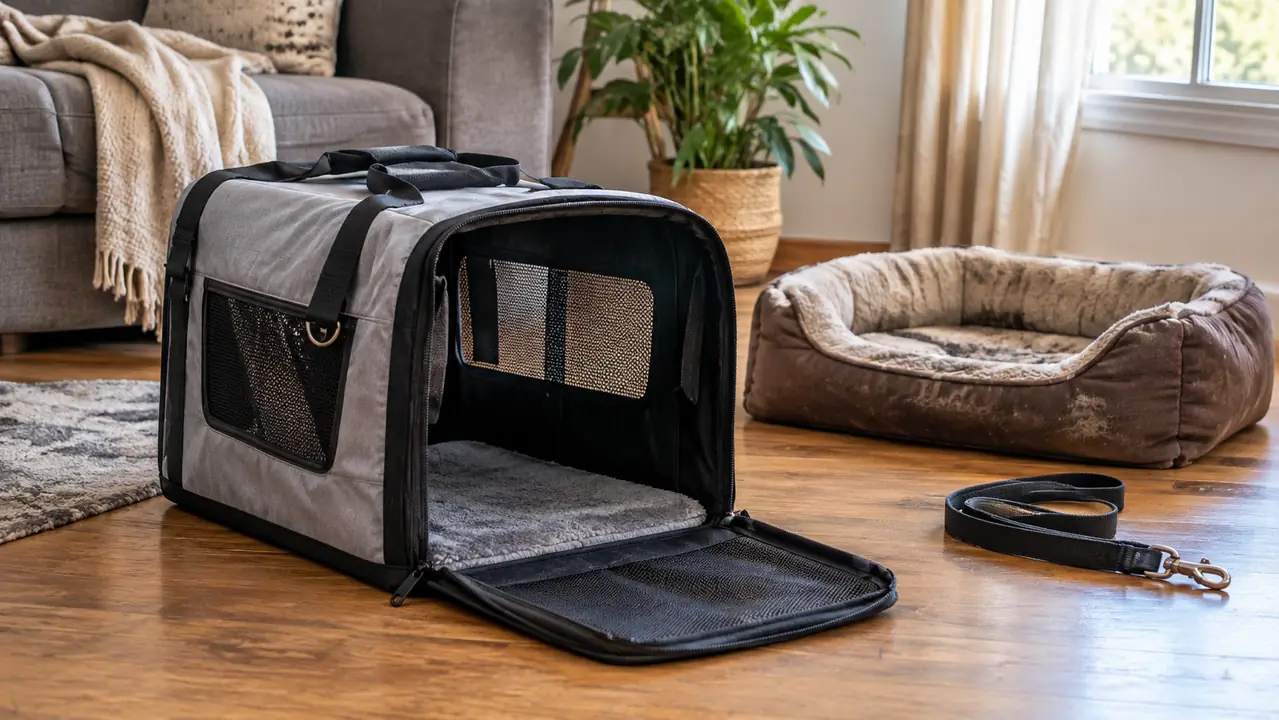
Not the laundry room. Not the garage. The room where your dog already flops down in the evening, which in my house is the living room, two feet from the recliner. Set the carrier down open and walk away from it. Do not coax, do not point at it, do not stand there watching to see what happens. A dog reads your interest as pressure, and pressure is the whole problem you are trying to avoid.
Leave it there for two full days. You will see the dog sniff it in passing, probably on the way to the water bowl, probably when you are not looking. That is the goal for this step, nothing more. The carrier has to stop smelling like a store and start smelling like the room.
Before any of that, I tried the shortcut with a borrowed cardboard vet carrier: set it by the door, put a treat inside, and shut the dog in the kitchen with it overnight. Two days of that and the dog would not walk past the doorway. Cardboard also soaks up every smell in the house and then holds onto it, which is its own small problem. So the first rule in my house now is that nothing gets closed until the dog is walking in on its own.
The liner that comes with the Sherpa is worth using from day one, because it is what the dog will be lying on in the car and it should not be a new smell on the day of the trip. If your dog is a chewer, pull the liner on the nights you are not home and put it back when you are.
Step 2: Make It the Only Place the Good Chew Shows Up
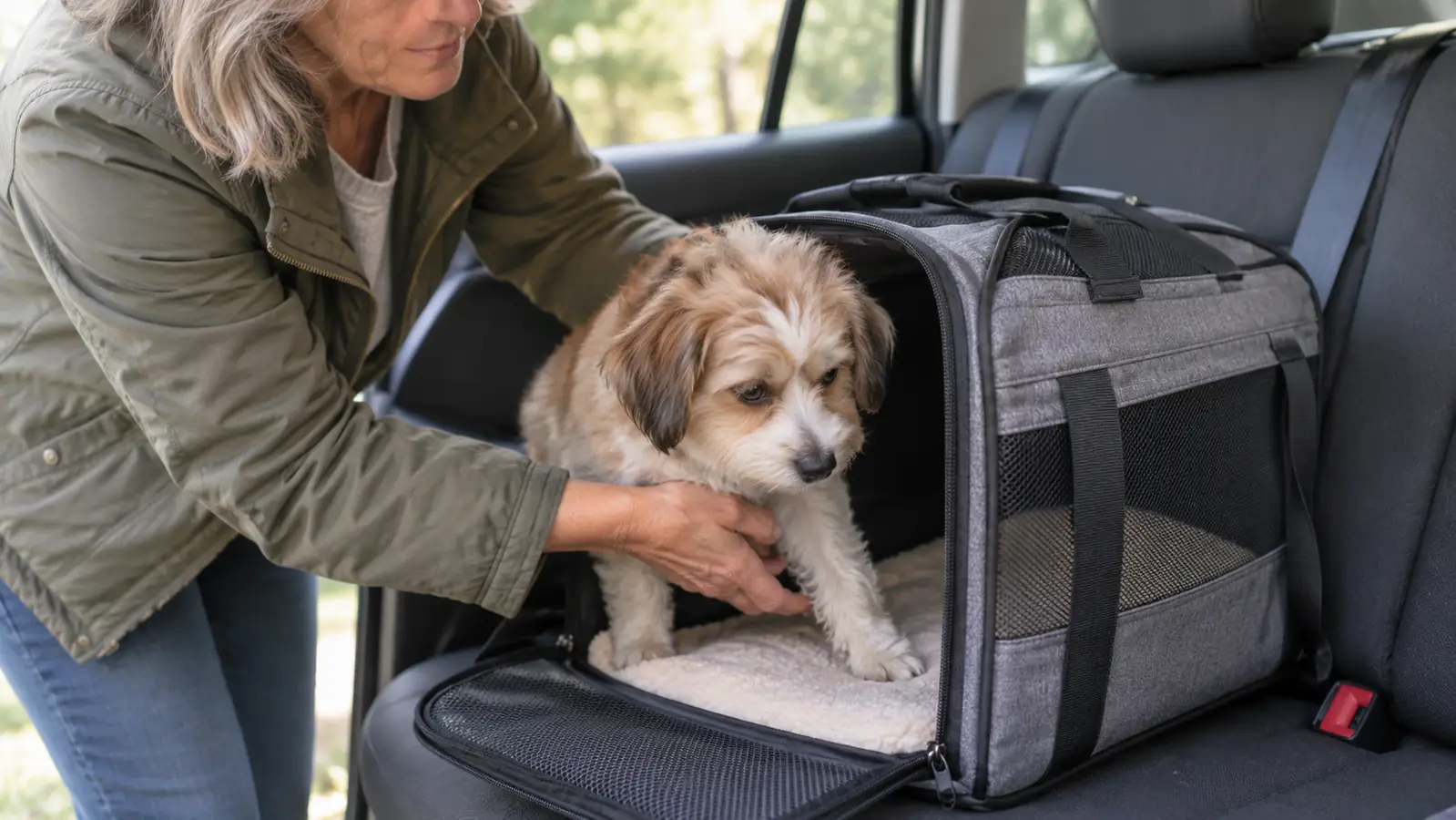
Day three. Pick one thing your dog genuinely wants and that you do not hand out otherwise. A bully stick, a stuffed frozen toy, whatever it is. From now on that item appears only inside the carrier, and only while you are in the room. No closing anything yet.
Most dogs will take the food with their front feet outside and their back feet inside for a day or two, which looks ridiculous and is exactly what you want. The back end going in first without a fight is the habit you are building. It is also the end that has to fold down later, so a dog that is relaxed about its rear end being near the back wall is a dog that will ride better.
The first dog I ran this on was Scout, back in April when the Sherpa was new to the house, and she is a terrier, so she did not do the feet-outside business. She took the food and left with it. It was four days before she put a paw inside while I was in the room, and six before she would lie down in there. If your dog is quicker than that, good. If your dog is slower, the timeline still holds, you just stretch step two by a few days and take it back out of step five.
If the dog will not go near it after three days, stop feeding meals in the bowl and put the bowl just inside the opening instead. Hunger is not cruel here, it is just a lower bar than enthusiasm. If your dog is guarding food or snaps when approached, that is a different problem and one to take to your vet or a trainer rather than work out on your own.
Step 3: Close It for Four Seconds, Not Four Minutes
Day five or six, depending on how step two went. The dog goes in for the chew, you close the carrier, you count to four, you open it. That is the entire session. Then again a few minutes later, and maybe a third time that evening. Short and boring beats long and dramatic every time, and the dog learns that being closed in is a thing that ends.
Build from four seconds to about thirty over the better part of a week. Stay in the room the whole time. Sit on the floor if that is what it takes, and do not make a production out of the moment you open it. If the dog whines at ten seconds, you went too fast, so drop back to five and hold there another day.
One transport dog, a little thing well under ten pounds, whined through the entire first four-second close and quit the instant the zipper moved. That told me more than any article did: the noise was not fear of the box, it was not knowing when the box ended. Once a dog learns the zipper always opens, the whining turns into an opinion you can politely ignore. I keep my hand on the zipper pull rather than the handle during these sessions so the sound and the opening arrive together.
One thing I would not do is feed a nervous dog a full meal right before any of this. A dog that gets carsick has enough going on without a stomach full of dinner, and a dog that is fine in the car will still be fine on an empty stomach. Anything beyond that, appetite or nausea or drooling that does not quit, is a conversation for your veterinarian.
By the end of week one the carrier should have stopped being a car thing and started being a piece of furniture. That is the whole trick, and there is no faster way to it.
Step 4: Move It to the Car Before the Dog Thinks It Means a Trip
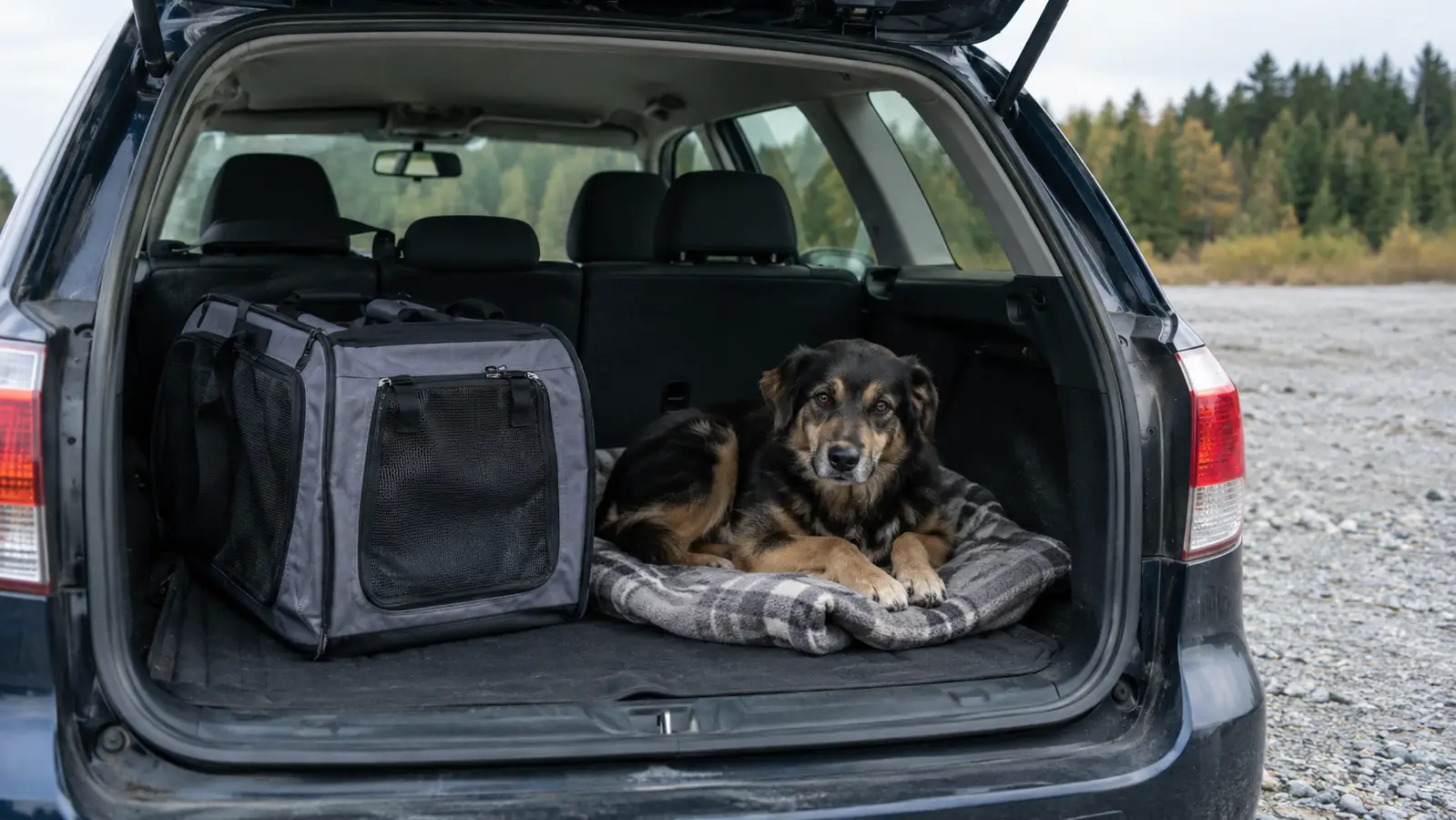
Day eight or nine. Carry the closed, empty Sherpa out to the Outback and set it on the back seat. Bring the dog out, let it get in, feed the chew, close the carrier, count to ten, open it, go back inside. No engine, no keys, no driving. Do that twice, then do it a third time a day later with the engine running and the car sitting still in the driveway.
This is the step where the Sherpa's frame earns its keep. The listing describes a patented spring wire frame that lets the rear end of the carrier be pushed down several inches, which is how a soft carrier sits flat on a seat instead of rolling forward every time you touch the brake. On a back seat with a hammock on it, I set the carrier on the passenger side, press the back down, and it stays put.
The back seat of the Outback measures about 54 inches across, and the Sherpa at 19 inches long takes up a little over a third of that, so on transport days the carrier sits on the passenger side and Scout rides on the hammock on the driver side and neither one touches the other. Measure your own back seat before you count on that. In a compact car the carrier eats most of the seat and you have to decide which dog rides where.
Lift it by the padded top handle when the dog is inside, not by the shoulder strap. The strap is fine for a cat or an empty carrier, but an eighteen pound dog swinging from one shoulder gets old by the second parking lot. The listing says up to 22 pounds and I believe the number, though Scout at 18 fills the Large completely, so a dog near the top of that range is going to be snug.
Step 5: Three Drives to Nowhere Before You Go Anywhere Real
Day ten through fourteen. Carrier in the car, dog in the carrier, and you drive around the block and come home. Then a five minute loop the next day. Then ten minutes out to the county road and back. Nothing at the end of any of these, no vet, no park, no payoff. The point is that the car becomes unremarkable.
The county road loop is the one that tells you the truth, because it has a stop sign, a railroad crossing, and a quarter mile of patched asphalt that rattles anything not tied down. Ten minutes out, ten back. If the dog is quiet over the tracks, you have done the work. If it is still pawing at the mesh at the turnaround, go back to five minutes and give it another week. There is no prize for finishing the two weeks early.
Two rules I hold to on the road. The carrier rides on the back seat, never the front, and never stacked with anything on top of it. And the dog comes out of the carrier at stops on a leash, because a small dog that bolts in a gravel lot at a truck stop is how people lose dogs. Scout never wears her harness and rides in the carrier at the same time, it is one or the other, never both.
If your plan involves a flight, understand that I have never flown with a dog and I am not going to pretend otherwise. The listing says airline approved and guaranteed on board, and that is all I can tell you. Call your airline, get the cabin requirements in writing for your specific aircraft, and check them again the week you travel.
What Else Helps
A back seat cover under the carrier does more than protect the upholstery. Cloth seats are slick, and a soft carrier on bare cloth slides when you stop short. My hammock holds the Sherpa in place, and the carrier in turn holds the dog. The straps on that hammock need snugging every few weeks, and nails leave marks on the surface, so it is not a permanent solution, just a better one than towels.
A bowl of water at the halfway point matters more than a bowl of food. The collapsible bowls I carry clip to the leash, one per dog, and the transport dogs get a fresh one and never share. Keep the water in the cargo area rather than the cabin, because a jug that tips in the back seat is a bad afternoon. Do not leave a dog in a parked car, not for five minutes, not with the windows cracked, not in Wisconsin in April when it feels cool out.
And keep the carrier out between trips for a few weeks after the training is done. A dog that only sees it on vet day will unlearn the whole thing by summer. Mine goes back on the garage shelf eventually, but it comes down a day early before any appointment so the dog has time to walk past it and remember it is nothing.
Two Weeks of Boring Practice Beats a Calm Dog on the Day Of
The Sherpa Original Deluxe in Large is 19 by 11.75 by 11.5 inches, weighs 3 pounds, includes the liner and the detachable shoulder strap, and carries a one-year limited warranty from Sherpa. It fits pets up to 22 pounds on paper. Measure the dog, then start at step one.
Amazon Check Today's Price on Amazon →