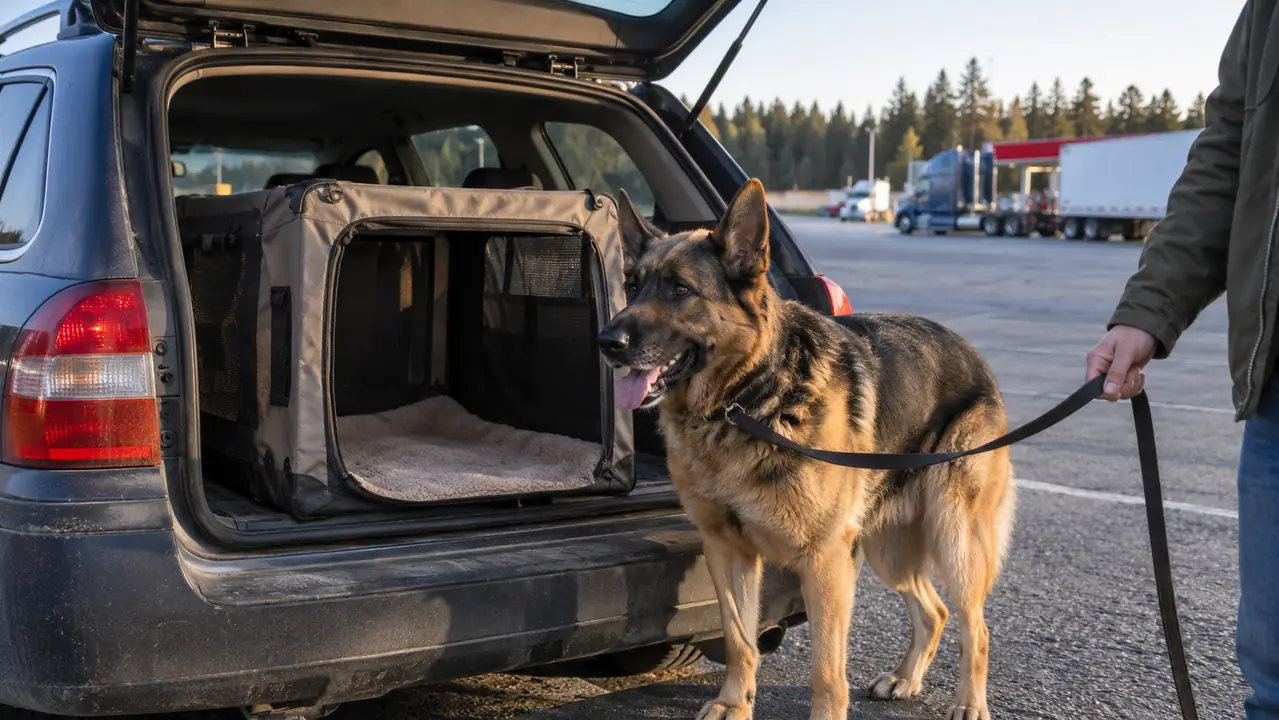
For years I figured a dog in a car just needed a blanket and a window cracked open. Then I started driving one rescue transport leg a month, ninety miles down I-94 from Eau Claire to a truck stop in Tomah, and I changed my mind about that. What a dog needs at a handoff is not a blanket. It is a small, shaded, familiar box to stand in for ten minutes while two strangers pass paperwork back and forth over the roof of a car. That is the job the DONORO pop up crate does for me. It is not a crate I drive with. It is a crate I open in the back of my Outback while the car is parked and the hatch is up.
The DONORO crate measures 28 inches long by 18 inches wide by 22 inches tall and weighs about 3.3 pounds. It has a wire frame, a zipper closure, three mesh windows, and a pad that comes in the box. Folded flat, it rides in my cargo area for weeks at a time without me noticing it is back there. I bought it in May, after four months of hauling dogs in a car that already had a back seat hammock, a harness, two collapsible bowls and a soft carrier in it. What I wanted was somewhere to set a dog down at a stop. What I did not want was another thing to install.
What it replaced was nothing, and that is worth saying too. Before the crate, the resting spot at a stop was the tailgate with a towel on it, or the ground next to the car with a hand on the leash. Those work right up until it rains, or the pavement is hot, or there is a truck idling six feet away. I looked at the soft crates the rescue keeps in the supply room and I looked at what other volunteers use, and I went with this one because it folds flat enough to live in the car. A crate you leave at home does not help you at a truck stop in Tomah.
One thing up front, because this is the part people skim past. The listing does not claim this crate is crash tested, and I do not drive with a dog inside it. Scout rides on the back seat hammock in her Kurgo harness, clipped in, and she rides there whether we are going to Tomah or going to the vet. The DONORO comes out of the cargo area only when the car is stopped and I am standing next to it. That is the whole setup I am about to describe, and it is worth saying plainly before the steps.
The 3.3-pound crate that rides flat in my cargo area and opens at the handoff
28 by 18 by 22 inches, wire frame, zipper closure, three mesh windows, pad included. It is a parked-stop crate, not a driving crate. That is exactly how I use it, and it does that job without complaint.
Amazon Check Today's Price on Amazon →Here is the order I do it in. I have done it in a snowbank in February and I have done it in ninety-degree sun in July, and the order does not change.
Step 1: Park, shut the engine off, and open the hatch before you unzip anything
Pick a spot where you are not in the flow of traffic and where you can see what is coming. At the Tomah truck stop that means the far row, nose out, away from the fuel lanes. Wherever you stop, the dog stays on a leash and the leash stays in your hand until the crate is open and ready. I clip Scout's leash to my belt loop. It sounds fussy until the day a transport dog slips a collar in a parking lot with trucks moving through it, and then it does not sound fussy at all.
The hatch goes up before anything else comes out of the cargo area, and it stays up. On a warm day the hatch is the shade. On a cold day it is the windbreak. I do not open the crate on the tailgate and I do not set it on the pavement. I have watched people do both, and both times the dog ended up standing in a puddle of something, with a leash wrapped around somebody's leg.
Then and only then does the folded DONORO crate come out from behind the back seat. It is light enough that I can lift it with one hand while the other hand holds the leash, which matters more than any spec on the page. Everything else, the water jug, the bowls, the pad, waits until the crate is standing.
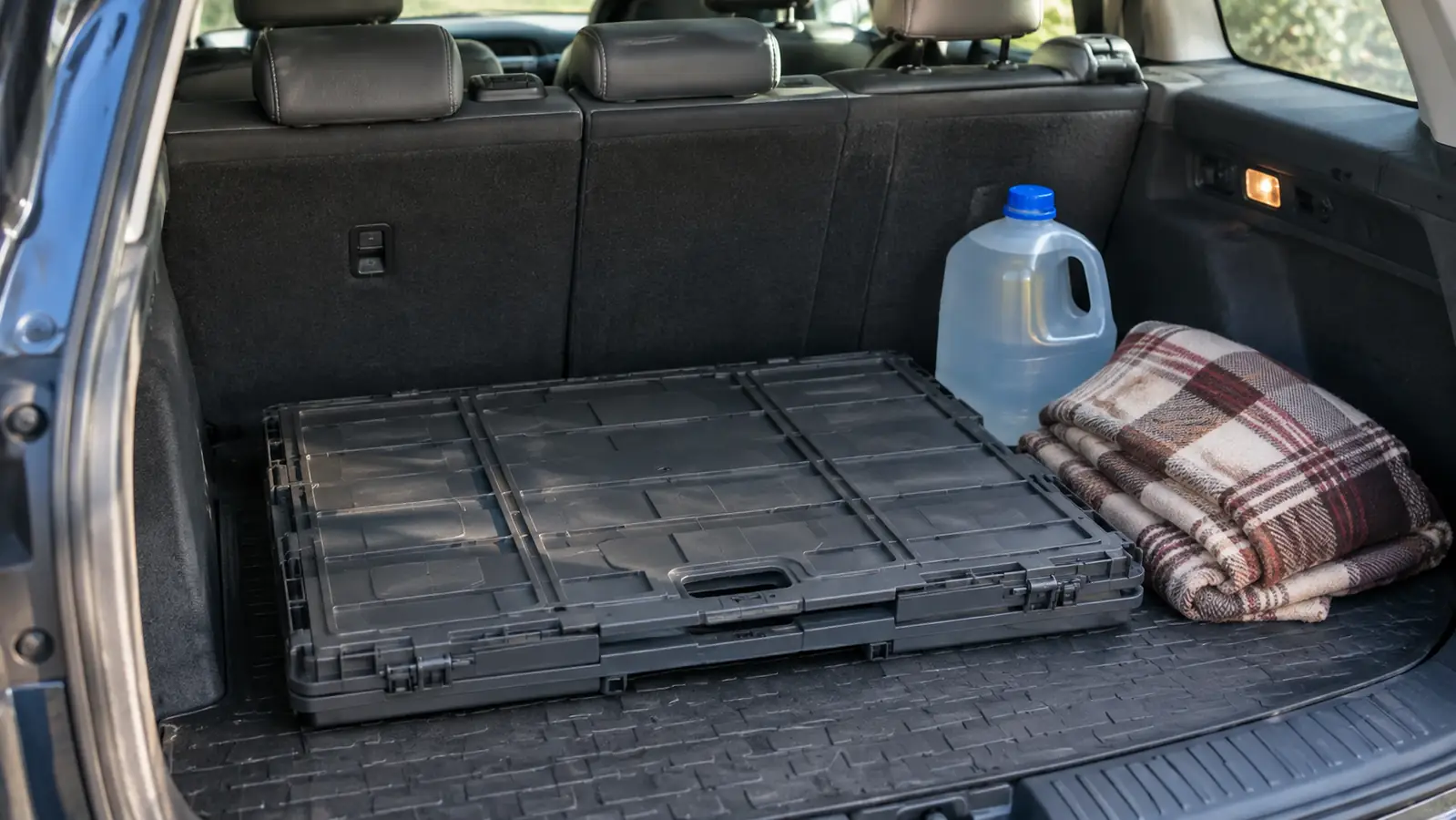
Step 2: Square the folded crate in the cargo area and check what is around it
I set it flat on the cargo floor against the back of the rear seat, long side across the car. The crate has nothing to strap to and neither does my cargo floor, so I do not pretend it is anchored. What I do instead is put it where it cannot wander, which means against the seatback, tight to one side, with the water jug and the folded blanket taking up the space on the other side. That is the honest version of securing a crate in a parked car.
Leave yourself room to work. The crate opens out to 28 inches by 18 inches, and you want a hand's width on the door side to reach the zipper without leaning over the dog. The Outback has the room behind the back seat. A smaller cargo area does not, and that is fine, because you can set the DONORO up on the ground beside the car with the dog on a leash next to you. What you should not do is jam it in so tight that the mesh presses against the seatback. The windows are the ventilation.
Take a second to look at what is loose. A cooler, a case of water, a bag of dog food, anything that could slide into the crate. Move it forward or move it out. The DONORO weighs 3.3 pounds and it will not stop a cooler, so do not ask it to.
Step 3: Pop the wire frame and check all three mesh windows
The frame pops open the way a pop up tent does, and it goes faster than you expect the first time. Work the frame open side to side, then press down on the floor until it sits square. If it looks cockeyed, it is cockeyed, and it means one corner is not seated. It should stand on its own with the top level. Mine takes a small shove at the last corner and then it is up.
Then walk the three mesh windows. The listing says the seams are protected and the corners are reinforced, and mine have held through a spring and a summer of monthly use and one very muddy Saturday in June. What I actually check is the zippers. Three windows means three zippers and three pulls, and I run each one open and closed before a dog goes anywhere near the crate. A pull that has worked its way half open is the one thing here that will let a dog out.
Last, the pad goes in flat, corners tucked, no fold. That pad is what comes in the box besides the crate itself, and it is the difference between a dog standing on wire and a dog lying down for ten minutes. If your dog is a scratcher, put the pad in anyway and expect to smooth it out at the next stop. I have never had one chew the pad, but I also do not leave a dog in there long enough to get bored.
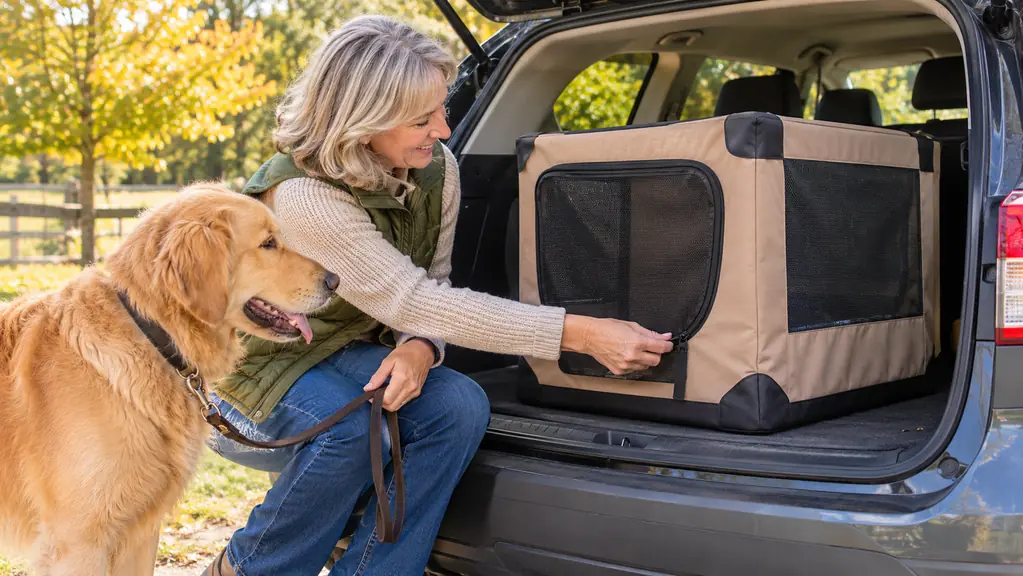
Step 4: Put the dog in, zip the door, and stay put
Lead the dog in on a slack leash and let them turn around once. If they will not go, do not push and do not lift. Set a treat just inside the door and give it ten seconds, and if that does not work, this is not the day for the crate. I have handoff dogs that walk in like they live there, and I have had one that wanted nothing to do with it. That dog stood next to me on the leash instead, and the world did not end.
Zip the door shut and check the pull is all the way home. Then I sit on the bumper with my hand on the crate. Not to fuss over the dog, just to be there. Ten minutes, maybe fifteen. The mesh on three sides means the dog can see me and I can see the dog, and that is most of the reason the crate works at all.
What the crate is not is a place to park a dog while you go inside and pay for gas. It is mesh and zippers, and mesh and zippers do not stop a determined dog. It is not for a chewer and it is not for a dog that panics. And nobody leaves a dog alone in a parked car, no matter what the dog is standing in. If I need to go inside, the dog comes with me or we skip it.
Step 5: Fold it back down before you drive
Pad out first, then the door zipped shut, then push the frame down from opposite corners. It goes down the way it came up, and the first three or four times it will fight you. Practice it in your driveway on a nice day, not in a truck stop parking lot with a dog watching. Now the DONORO folds in about the time it takes to load the water jug, and I have not once had to think about it.
Fold it flat and put it back behind the seat. The listing carries a one-year manufacturer warranty and I have not needed it, because the frame, the seams and the zippers have all held. The part I expect to wear first is the mesh, and that is true of every soft sided crate I have seen come through the rescue supply room, brand new or otherwise.
What Else Helps
The crate is the resting spot. Water is a separate job. I carry two SLSON collapsible bowls, one clipped to Scout's leash by its carabiner and one in the glove box, and a jug of water in the cargo area. At a stop each dog gets a clean bowl. They hold 12 fluid ounces, which is plenty for a terrier and not much for a big dog, so if you are hauling something larger, bring a bigger bowl and expect the collapsible one to tip over on gravel.
The rest of the car matters more than the crate does. The back seat hammock keeps hair and worse off my cloth seats, and the Kurgo harness keeps Scout in one place while we are actually moving. The DONORO handles the standing at a stop and nothing else. If you are deciding between this and a carrier, I have written about how the two compare, and the short version is that they do different jobs and I own both for that reason.
A word on the size. The listing title says medium dogs, and the listing itself warns that it just fits small dogs. Believe the warning. Scout is 18 pounds and she is about the size this crate suits. If your dog is 30 pounds and calm, I would still want to see it in person before I counted on it. Measure your dog and read the size line before you order.
And if your dog gets sick in the car, or shakes, or drools, that is a conversation with your vet, not something a crate fixes. I am not the person to ask about that. I have also never flown with a dog, so I cannot tell you whether any airline accepts this crate. The listing does not say it is airline approved. Call your airline and get it in writing before you count on it.
Three zippers, three pulls. I check every one of them before a dog goes in, and I have never once regretted the thirty seconds.
If your dog needs somewhere to stand at a stop, this is the one that lives in my cargo area
28 by 18 by 22 inches folded out, 3.3 pounds, wire frame, three mesh windows, pad included, one-year manufacturer warranty. Read the size warning first: the listing says it just fits small dogs, and at 18 pounds Scout has room to turn around in it and not a lot more.
Amazon Check Today's Price on Amazon →