
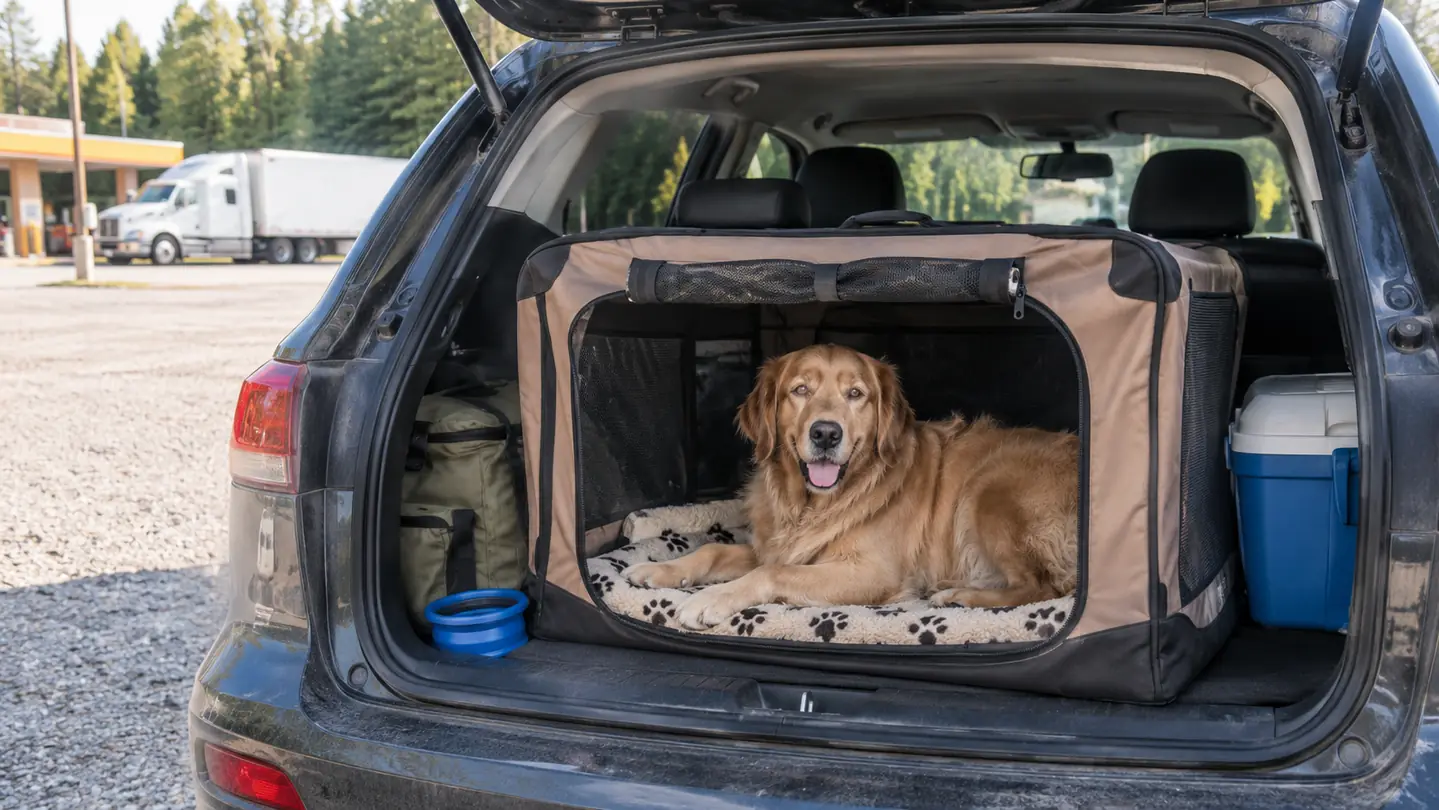
I bought the DONORO pop up crate in the second week of May, and for six months it has lived folded flat in the cargo area of my Outback, under a gallon jug of water and a stack of old towels. That is an odd place to keep a dog crate. But I did not buy it to be a crate in the usual sense. I bought it to be a place where a dog can lie down out of the sun at a truck stop in Tomah, Wisconsin, while I stand three feet away with a leash in my hand.
Here is the short version before the long one. It does that job well. It does not do several other jobs that people assume a crate does, and the listing itself warns you about the biggest one. If you want something to buckle a dog into for a drive down the interstate, this is not it. If you want a light, ventilated resting spot for a calm dog during a parked stop, it makes sense to own. Six months of monthly transport legs and a great many rest area stops is enough time to know the difference between those two things.
The Quick Verdict
A light, ventilated resting spot that earns its place at parked stops with a calm dog and a person standing right beside it. Not a crate you drive with, and not for a chewer.
Amazon Check Today's Price →The crate I open at every Tomah hand-off
Six months folded flat in the cargo area between transport days, opened at every parked stop. Look at the 28 by 18 by 22 size against your own dog before anything else.
Amazon Check Today's Price on Amazon →How I've Used It
I drive one transport leg a month for a small Wisconsin rescue, five years now, the second Saturday down I-94 from Eau Claire to a truck stop in Tomah. That is about ninety miles. I take my terrier mix Scout along. She is six and eighteen pounds, and she gets restless about forty minutes in. The crate is not for her in the car. She rides on the back seat on the hammock in her harness, clipped in, and that is the only place she rides.
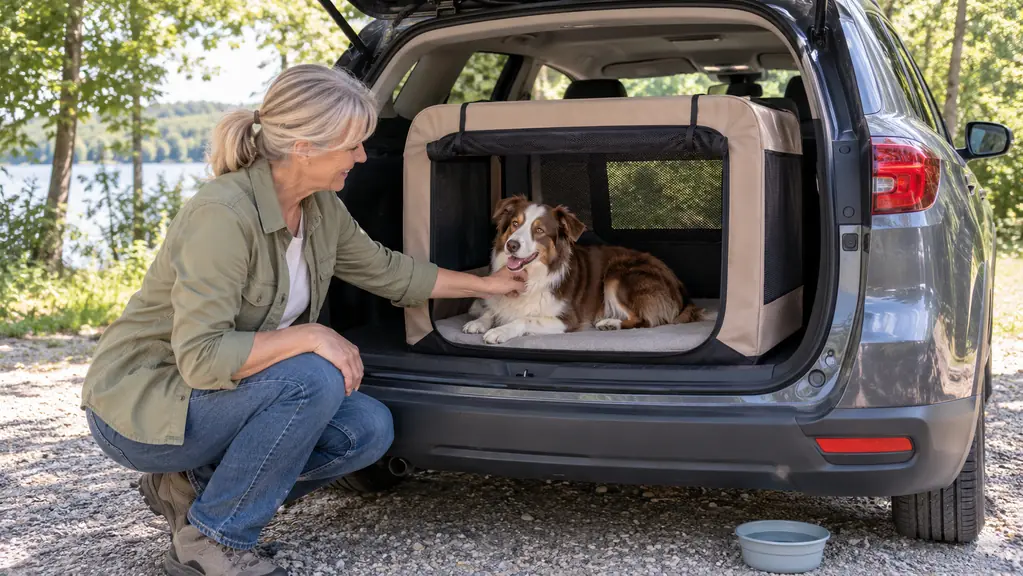
The crate is for the other end of the trip. When I pull into Tomah and the next driver is not there yet, I open the hatch, set the DONORO up in the cargo area with the hatch up for shade, and let the dog on board lie down. Sometimes that is Scout if she is wound up. More often it is a transport dog. Fifteen or twenty minutes with a bowl of water in front of it and a quiet place to stand and the whole tone of that hand-off changes. A dog that has been panting for an hour settles. Then the next driver pulls in, and the dog goes on.
What I do not do with it matters more than what I do. I do not drive with a dog inside it. I do not leave a dog alone in a parked car with it or without it, and if the weather is warm enough that I would not want to stand in a car, the dog does not either. I do not use it as a home crate, because there is a wire crate in my kitchen already. And I do not zip a dog into it and walk away, not even for two minutes at a rest area. I stand there, and when I go, the dog comes with me.
What Six Months of Transport Days Looks Like
There is a rhythm to a hand-off that nobody explains when you start doing this. The receiving driver is late maybe half the time, because of a fuel stop, a closed ramp, or a phone that died somewhere west of Black River Falls. That dead time is what this crate is for. Before May I spent it standing in gravel with a dog on a short leash, watching it pull toward the idling semis and refusing to settle. Now I spend it sitting on the tailgate with a dog lying down four inches from my boot. Same dead time, less work for both of us.
The three mesh windows do real work in that situation. With the hatch up and the crate set back in the cargo area, a dog inside can see out on three sides and catch whatever air is moving. I have used it on a warm July morning and a rainy October one, and both times the dog inside regulated itself better than it would have in a closed carrier. Ventilated is the word the listing uses. What it means in practice is that a dog is not breathing the same air twice.
I have opened this crate more than forty times since May, counting rest stops on ordinary errands, and the seams have held. The corners are reinforced the way the listing says, and nothing has separated at the mesh. That is not a durability medal. It is a piece of soft-sided gear doing what soft-sided gear should do when a person handles it carefully. The whole thing weighs about three and a quarter pounds, so it is not carrying much of its own mass around, and that is the point of it.
I keep a short mental list of what the crate replaced. A folded towel on the cargo floor, which a dog would not stay on. A leash wrapped twice around my wrist while I answered a text from the receiving driver. Nothing else. That is not a dramatic before and after. It is one less thing to manage at a moment when you are already managing a dog, a schedule, and a stranger's arrival all at once.
The Size Warning in the Listing Is Not a Formality
The listing title says medium dogs. The listing description then says, in plain text, that the 28 by 18 by 22 size just fits small dogs and would suit one or two cats. Believe the second one. Scout is eighteen pounds and she has room to turn around and lie flat with space left over. A dog at forty pounds could get in through the opening and would not be comfortable once it was in there. If your dog is north of about twenty five pounds, this is not your crate, whatever the title suggests.
Twenty two inches of height sounds generous until you picture what a dog does inside it. Scout can stand without ducking, and that is what the height buys you. What it does not buy you is a dog that can stretch out the way it does on a rug at home. This is a crate for lying down for twenty minutes, not for sleeping through the night. The pad that comes with it is thin, and thin is enough on a gravel lot and not enough for anything much longer than that.
The listing also offers a smaller size, 24 by 16 by 19, which it lists for extra small pets and small cats. If you are hauling a cat, or a dog under about ten pounds, that is the one to look at. I bought the DONORO in the larger size because Scout is eighteen pounds and she is the smallest thing that regularly gets in it. A cat in the larger crate would rattle around like a marble in a shoebox.
The Wire Frame, the Mesh, and the Zipper
The frame under all of this is metal, and that is why the crate does not sag like a laundry hamper. I have seen all-fabric soft crates at the rescue, the kind with nothing stiff inside, and a dog leaning on one wall of those takes the roof down with it. This one holds its shape with a dog pressed against a side panel. The closure is a zipper, the mesh panels are zipped, and the protected seams along the edges mean the zipper tape is not the first thing to give out.
None of that makes it a secure enclosure, and I want to be plain about it because the product title uses the words escape proof. I would not bet a dog on that word. Mesh and a zipper stop a dog that has decided to lie down. They do not stop a dog that has decided to get out. If your dog chews, scratches at doors, or panics in an enclosed space, this is the wrong tool and a wire crate or a hard carrier is the right one. A determined dog would be through that mesh before you finished crossing the lot.
The zippers are the part I actually watch. Six months of gravel dust and one muddy Saturday and they still run clean. I wipe them with a rag every few weeks and I do not force them when a panel is out of line, because that is how zipper tape gets chewed up. That is common sense rather than a feature, but it is the kind of thing that decides whether a soft crate lasts two seasons or five.
What I Liked
- Three mesh windows give real airflow with the hatch up
- Metal wire frame holds its shape instead of sagging onto the dog
- About three and a quarter pounds, so it comes in and out of the cargo area one handed
- Folds flat enough to live under a water jug between transport days
- The listing states the 28 by 18 by 22 fit honestly as a small dog size
- One year manufacturer warranty
Where It Falls Short
- The title says medium dogs while the description says small dogs
- The included pad is thin, fine on gravel and not much beyond that
- Folding it back down takes practice and a clumsy first attempt is normal
- Mesh and zippers will not hold a chewer or a panicked dog
- Twenty two inches lets a dog stand but not stretch out
Fifteen minutes in a shaded crate with a bowl of water changed the whole tone of a hand-off. A dog that had been panting for an hour settled.
Setting It Up and Folding It Down Takes Practice
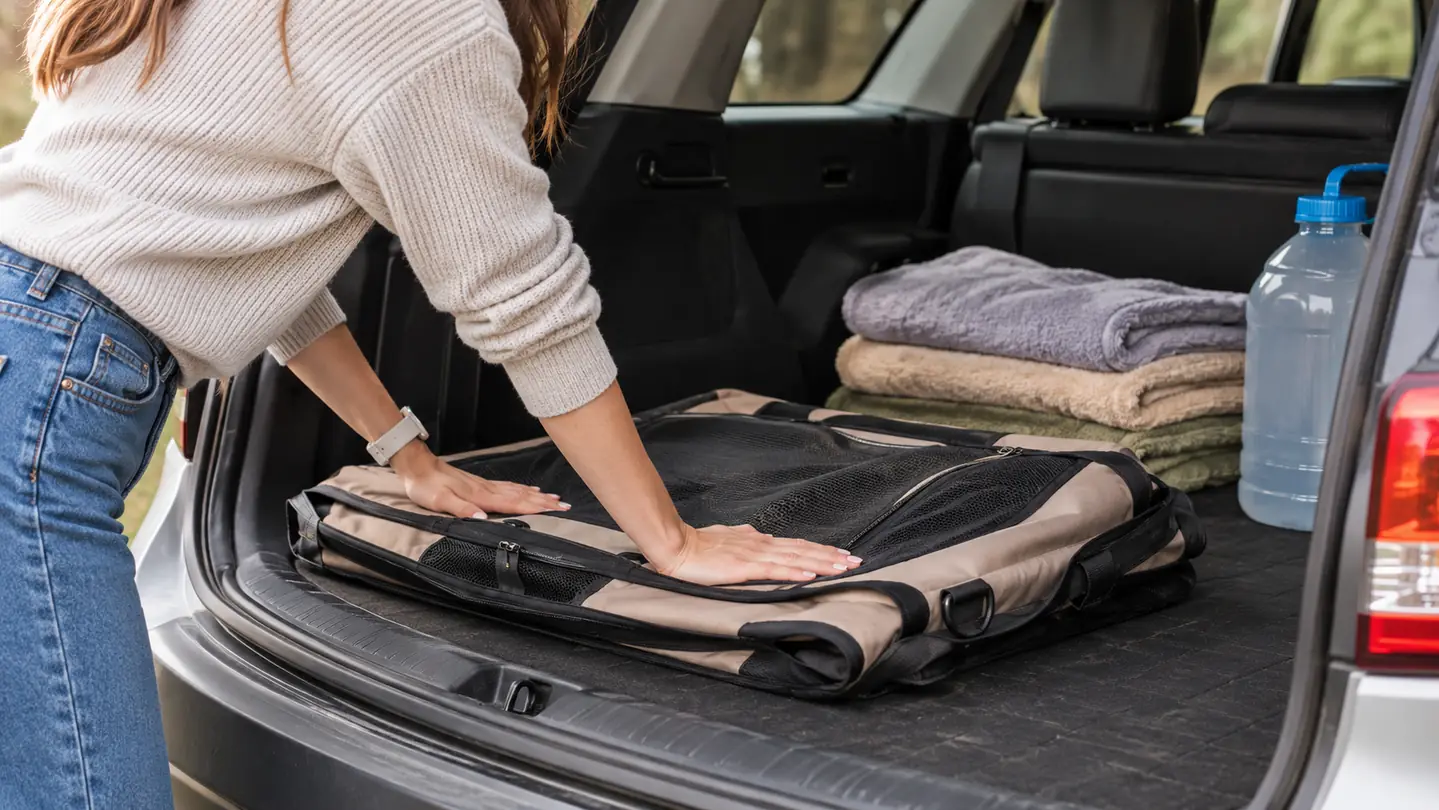
Opening it is the easy direction. You take it out of the cargo area, hold the frame, and let it come up. The first time, mine took about a minute and a half because I was being fussy about the mesh. Now it is maybe ten seconds. Folding it back down is the direction that humbles you. The frame has to go a particular way and it will tell you when you have it wrong by simply refusing to move. I practiced in the driveway three times before I trusted myself to do it in the rain at a rest stop.
The base is slip resistant, which matters more than it sounds. Gravel lots are not level, and a crate that slides when a dog shifts its weight is a nuisance you do not need while holding a leash and a water bowl. Set it on the tailgate or in the cargo area and it stays put. I have not had it tip. I have had it settle a quarter inch into soft ground on one corner, which is what any four-cornered object does on gravel, and I put a folded towel under the low corner when that happens.
Where It Rides in the Car, and Where It Does Not
Folded, it takes up less space than a cooler. It sits in the cargo area of the Outback behind the back seat and it has been there since the day I bought it, apart from the times it was open. That is the whole reason I settled on this over the hard sided carrier I looked at, one a volunteer had at the rescue. That carrier is sturdier and I would rather have it in a collision, but it is heavy, and it would not live in my car permanently. I never owned one, so take that as an observation and not a comparison test.
In the back seat it does not go, because the hammock is there and Scout is there in her harness. In the front seat it does not go either, and no dog of mine rides in the front seat of anything. If you are picturing a crate strapped to the passenger seat with a dog inside while you drive, that is a picture I would not put in your head. Open it when you are parked, fold it when you are not, and it is a good piece of gear. Do the other thing and it is a soft bag with your dog inside it in a moving vehicle.
My load-out for a transport Saturday is the same every month, and the DONORO crate is one line on the list. Hammock already installed. Harness on Scout before she gets in. Two bowls, one clipped to the leash and one in the glove box. Water jug in the cargo area. Crate folded next to it. That is the whole kit, and it fits behind the back seat with room left for a bag of towels.
Who This Is For
This suits someone who does what I do, or something close to it. You drive a leg, you stop, you wait, and you want the dog comfortable and contained while you do. It suits a dog under about twenty five pounds that is calm in a small space and does not work at zippers. It suits a person who will practice the fold and leave the crate in the car so it is there when it is needed. And it suits anyone who has stood in a gravel lot at a hand-off, holding a leash and watching the clock.
Who Should Skip It
Skip it if your dog chews, panics, or has ever gotten out of something you were sure was closed. Skip it if your dog is over about twenty five pounds, because the listing's own description tells you the fit stops well short of medium. Skip it if what you actually need is a crate to drive with a dog inside, since this is not that and no soft-sided crate is. And skip it if you want one crate that covers the house, the vet, and the truck stop, because this is not the house crate. I still keep a wire crate in my kitchen and I would not swap it.
A resting spot for the wait, not a crate for the drive
Six months in the cargo area of one Outback, opened at every Tomah hand-off and most rest stops in between. Check the size against your own dog and read the listing's fit note before you buy.
Amazon Check Today's Price on Amazon →